
Your insurance company expects you to take reasonable steps to prevent further damage after a loss. In simple terms, that means you cannot discover an active roof leak, ignore it for three days, and then expect the carrier to pay for every inch of additional water damage that could have been avoided.
Temporary roof repair is not about permanently fixing the roof yourself. It is about protecting the building envelope, stopping wind and water from making the damage worse, and creating a clear paper trail that shows you acted responsibly.
Roofs in Florida deal with hurricanes, summer thunderstorms, hail, wind driven rain, high humidity, and, in areas like Pompano Beach and Miami, the strict rules of High Velocity Hurricane Zones. A quick roof patch that might survive a light rain in another state may fail fast in Florida weather.
This guide explains how temporary roof repair works, what you can safely do before professionals arrive, when to stop and call for emergency help, and how to protect your insurance claim in the process.
Florida Laws: Duty to Mitigate Damage for Insurance Claims
A duty to mitigate damage means you are expected to take reasonable action to prevent additional damage after you discover a problem. Most homeowner insurance policies include this requirement in a section often called “Duties After Loss.” The exact wording depends on your policy, but the concept is simple: protect the property, document the loss, notify the carrier, and avoid letting preventable damage get worse.
Florida courts also recognize the common law doctrine of avoidable consequences. In plain English, that means an injured party generally cannot recover damages that could have been reasonably avoided.
Here is what that looks like in real life.
If a storm tears open part of your roof and rain enters the home, the initial roof damage may be part of the covered loss. But if you make no effort to tarp the opening, dry the wet area, or call for help, your insurance company may push back on the later interior damage. The carrier may argue that the extra drywall damage, mold growth, insulation damage, or flooring damage could have been prevented.
There is another Florida specific issue to keep in mind: roof age.

Under Florida Statute § 627.7011, when a roof is at least 15 years old, an insurer must allow the homeowner to obtain an inspection by an authorized inspector before requiring roof replacement as a condition of issuing or renewing a homeowners policy. If that inspection shows the roof has five years or more of useful life remaining, the insurer may not refuse to issue or renew the policy solely because of roof age.
The 15 year rule is a powerful protection for Florida homewoners, but only if you have current roof inspection documentation.
If you do not know when your roof was installed, find out. If your roof is approaching 15 years old, schedule a qualified residential roof inspection before there is a problem. A recent inspection can help protect your coverage, support future claims, and prevent avoidable disputes about wear and tear.
For temporary roof repairs, your duty to mitigate usually comes down to three actions:
- Document the damage before you touch anything. Take photos and videos of the roof, ceiling, walls, floors, furniture, attic, gutters, and exterior damage. If you hire a roof inspector or emergency repair team, keep every receipt for your insurance claim.
- Cover openings that allow wind or water into the structure. That may mean tarping a damaged roof section, covering a hole with plywood, sealing a small puncture, or calling an emergency roof tarping service.
- Dry out wet interior areas quickly. Remove standing water, use fans or dehumidifiers if safe, and contact water mitigation professionals when moisture reaches drywall, insulation, flooring, or attic spaces. This helps reduce the risk of mold and organic growth.
Think of mitigation as the bridge between the storm and the permanent repair.
How to Temporarily Patch a Hole in Your Roof Before Professionals Arrive
Florida roof repairs need to account for Florida conditions.
A patch that is loose, poorly sealed, or fastened into the wrong material can fail during the next round of rain. In hurricane prone regions, summer storm corridors, and regulated HVHZ areas like Pompano Beach, temporary roof repair needs to be treated with the same seriousness as the permanent repair plan.
Before you do anything, decide whether the work is safe.
Do not climb onto a wet roof. Do not walk on tile. Do not approach downed power lines. Do not work during active lightning, high winds, or heavy rain. If the roof is steep, slick, unstable, sagging, or visibly damaged, call professionals.
Crown provides 24/7 emergency roof repairs in Florida for homeowners and property owners who need urgent help stabilizing damage before it turns into a larger claim issue.

Patching an Asphalt Shingle Roof Hole
Asphalt shingle roofs are the easiest roofing systems to temporarily cover, but “easy” does not mean risk free.
If you can safely access the area, start by documenting the damage. Photograph the missing shingles, punctures, lifted shingles, exposed underlayment, interior water stains, and any debris that caused the damage.
For a temporary patch, your goal is to redirect water away from the opening.

How to Tarp an Asphalt Shingle Roof
Traditional tarping works best on asphalt shingle roofs because tarps can usually be anchored with boards and fasteners without destroying brittle roofing materials.
Common tarp materials include blue polyethylene tarps, thicker plastic sheeting, and rubber roof sheets. In Florida, use the strongest tarp available because sun, heat, and wind can break down thin materials quickly.
The tarp should extend well beyond the damaged area on all sides. If possible, run the upper edge over the ridge of the roof so water flows over the tarp instead of under it. Secure the tarp with boards along the edges to spread the load and reduce wind lift. Avoid loose corners, loose wrinkles, and open edges where wind can get underneath.
The most common DIY tarp failure is the fastening. If the tarp is too small, too loose, or only held down at a few points, the next storm can turn it into a sail. Once wind gets under the tarp, it can rip away and expose the damage again.

How to Waterproof a Shingle Roof Leak
For small shingle roof openings, temporary waterproofing may involve:
- Roofing cement and tar can help seal small cracks, lifted shingles, nail holes, or puncture points.
- Roofing tape can provide a quick water resistant barrier over a small split or seam.
- For larger holes, a plywood patch may be used beneath or over the damaged area, with tar paper or roofing membrane layered above it to shed water.
Roofing cement and tape meant to limit water intrusion until a licensed roofing contractor can inspect the damage and complete a code compliant repair.
Temporarily Tarping Tile and Metal Roofs
Many Florida homeowners have clay tile, concrete tile, or metal roofing. These systems require a different approach.
Traditional tarping methods can cause new damage if they rely on nails, screws, or aggressive fasteners. Tile can crack under foot traffic. Clay tile can shatter. Concrete tile can break at corners or hidden stress points. Metal panels can be dented, scratched, or punctured if fastened incorrectly.
For tile and metal roofs, temporary tarping is usually best handled with non-invasive methods.

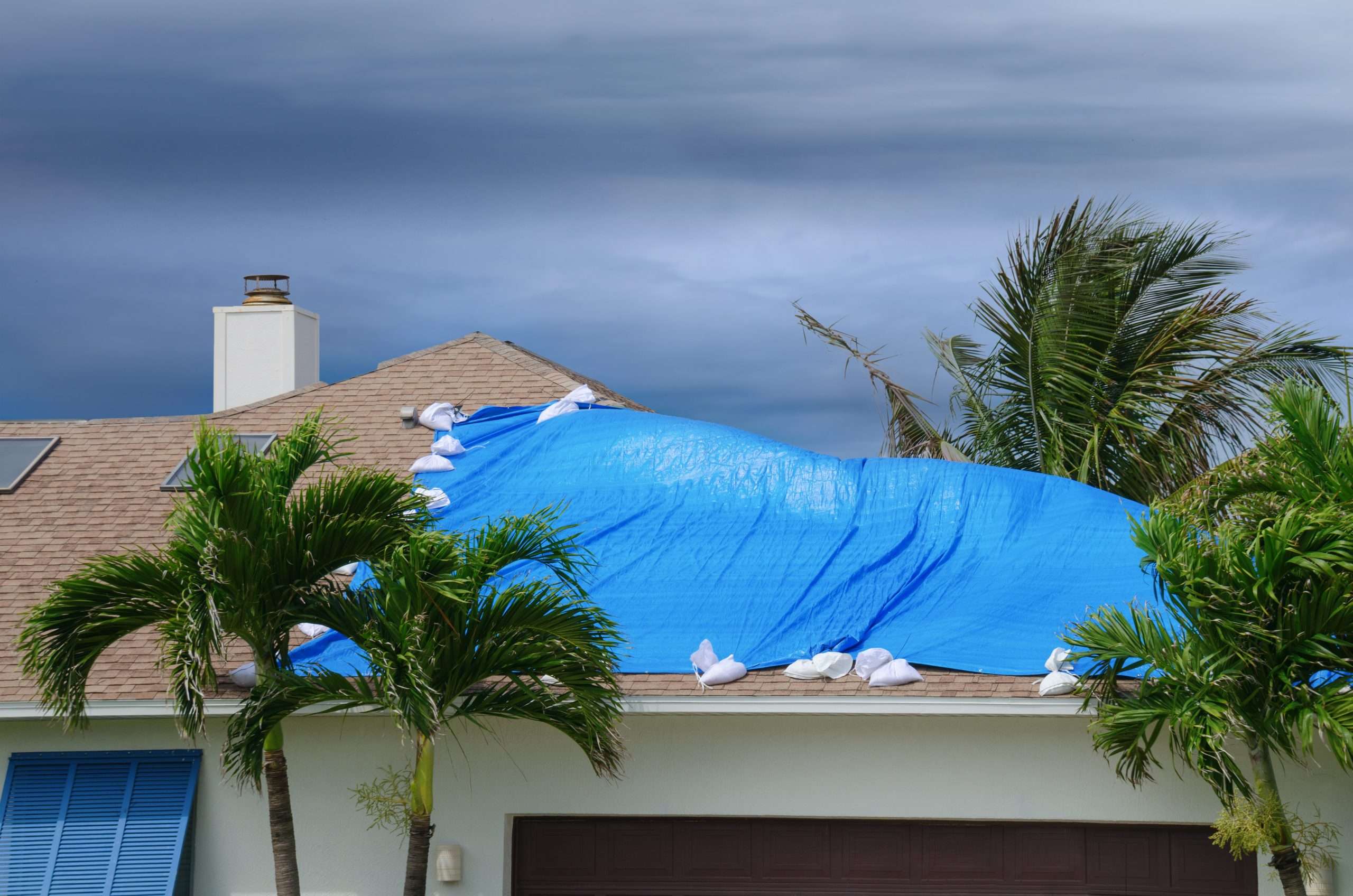
That may include weighted sandbags, tarp clips, adhesive roof tarps, waterproof tapes, ropes, or edge anchoring that avoids penetrating the roofing surface. The goal is to secure the covering without creating new holes.
The tarp still needs to extend beyond the damaged area, and the top edge must be positioned so water flows over the barrier instead of underneath it. On tile roofs, the tarp often needs to conform to the uneven surface without putting pressure on fragile high points. On metal roofs, the tarp must be secured tightly enough to prevent flapping, which can scratch coatings and reduce performance.
This is where many DIY repairs fail.
Tile and metal roofs are not forgiving. If you are not sure how to secure the tarp without breaking tile, puncturing panels, or creating a new leak path, call a professional emergency roof tarping service.

DIY Repair for a Commercial Flat Roof
Temporary roof repair becomes even more strategic on commercial buildings.
For asset managers, landlords, and commercial property owners, a flat roof leak is not just a maintenance issue. It is a risk management issue. Water intrusion can affect tenants, guests, inventory, electrical systems, insulation, interior finishes, and building operations.
Most commercial flat roofs use TPO, EPDM, PVC, or modified bitumen. These systems fail differently than residential shingles or tile. Storm damage may appear as punctures, membrane splits, seam separation, blistering, flashing failure, ponding water, or saturated insulation beneath the surface.
For small, visible punctures on a flat roof, the basic emergency process is usually:
- Document the damage with photos and videos.
- Remove loose debris from the area.
- Dry the surface if conditions allow.
- Identify the membrane type before applying any product.
- Use a compatible patch, tape, sealant, or mastic.
- Extend the patch beyond the damaged area.
- Monitor the interior for continued water movement.
Compatibility is the key word.
TPO, EPDM, PVC, and modified bitumen require different repair materials. A product that bonds to one membrane may fail on another. For example, EPDM often needs compatible rubber patches and adhesives, while modified bitumen repairs may use roofing cement with reinforcing mesh. Ideally, have your home’s roofing materials documented before storms so you can quickly and easily get the correct patching supplies.
If the roof has ponding water, saturated insulation, multiple punctures, active electrical risk, or damage near HVAC equipment, call a commercial professional.

When to Hire a Professional Emergency Roof Tarping Service
DIY temporary roof repair has limits. Call a professional immediately if:
- Water is actively entering the home or building
- The roof has a large opening
- The roof is steep, wet, unstable, or storm damaged
- Tile or metal roofing needs tarping
- The leak is near electrical systems
- Ceiling drywall is sagging
- Mold or musty odors appear
- Multiple rooms are affected
- A commercial tenant space is at risk
- The building has a flat roof with ponding water
- You need insurance ready documentation
This is also the smart move when you are dealing with an older roof, a high value property, a rental property, an HOA controlled property, or a commercial building.
One wrong step on a damaged roof can create more damage. One missing photo can weaken a claim. One improper tarp can fail before the next storm cell arrives.
The Benefits of Professional Roof Tarping Services
A professional roof tarping team brings better diagnostics, safer access, stronger materials, and stronger documentation.

Advanced Diagnostic Tools
Thermal imaging and infrared thermography can help identify moisture patterns that are not visible to the eye. Wet insulation and trapped moisture often behave differently than dry materials, which allows trained professionals to locate areas of concern before water damage spreads.
Electronic leak detection, often called ELD, is especially valuable on certain low slope and waterproofing systems. It uses electrical current to locate breaches in membranes by identifying where water can pass through a damaged surface.
Non-invasive moisture meters can also help map interior moisture through drywall, wood, and other materials without unnecessary demolition.
Professionals do not just cover the leak. They work to understand where the water is coming from, where it is traveling, and how far the damage may have spread.

Commercial Grade Tarps and Fastening
Professional roof tarping systems use stronger materials and better fastening methods than most DIY setups. Crews may use UV resistant tarps, reinforced seams, weighted anchoring, wrapped boards, temporary membranes, specialty adhesives, and fastening patterns designed to resist wind lift. In Florida, when a loose tarp can fail quickly in a strong afternoon storm, a properly installed professional tarp is designed to hold its position long enough for a permanent repair or replacement plan to move forward.
Experience to Provide Lasting Results
Water rarely travels in a straight line.
The stain on your ceiling may be ten feet away from the actual roof opening. Water can enter at a flashing point, follow a rafter, travel along insulation, and finally appear in a completely different room.
Experienced roofers know how to trace water movement. They look uphill from the interior stain. They inspect penetrations, valleys, roof edges, vents, fasteners, seams, and transitions.
That experience matters because temporary repair only works if the right area is protected.
Professionals also understand wind resistance. A DIY tarp may work in light rain but fail when the wind rises. A professional tarp is installed with wind movement in mind, using stronger edge control and more secure fastening.
What to Do After a Temporary Roof Repair
Once the roof is temporarily stabilized, the job is not finished.
The next steps protect your property and your insurance claim.
First, keep documenting. Take photos after the tarp or patch is installed. Save receipts for tarps, plywood, sealants, fans, dehumidifiers, emergency services, and professional inspections. If you pay for emergency work, keep the invoice.
Second, monitor the interior. Check ceilings, walls, attic insulation, flooring, closets, and areas around light fixtures. If moisture continues, the temporary repair may not be holding or the leak may be coming from another location.
Third, contact your insurance company according to your policy requirements. Provide clear information, but do not guess. If you do not know whether the damage is wind, hail, fallen debris, or a combination, say that the damage occurred after the storm and that a professional evaluation is underway.
Fourth, schedule a full roof inspection. Temporary roof repair is only meant to buy time. A licensed contractor needs to evaluate the damage, identify the root cause, and provide a long term repair or replacement plan.
Fifth, do not delay permanent repairs. In Florida heat and humidity, trapped moisture can move quickly. What starts as a small leak can lead to mold, insulation damage, wood rot, and structural decay if it sits too long.
Get Crown On It
Crown Roofing provides 24/7 emergency roof repairs in Florida to make sure short term damage does not become a long term problem. Our teams support homeowners, landlords, property managers, and commercial owners with emergency stabilization, drone powered inspections, photographic documentation, and clear next steps.
Crown serves Florida through four main hubs in Tampa, Fort Myers, Pompano Beach, and Sarasota. You can call any time of day to leave a message, or call during office hours from 8 am to 6 pm to get scheduled as soon as possible.
FAQs About Temporary Roof Repair in Florida
Will my insurance company reimburse me for a temporary roof repair?
Insurance may reimburse reasonable temporary roof repair costs if the repair was necessary to prevent further covered damage. Document the damage first, save all receipts, and confirm your policy requirements with your insurer.
How long do I have to file a claim after discovering storm damage?
In Florida, property insurance claims are generally barred unless notice is given within one year after the date of loss, with supplemental claims generally limited to 18 months after the date of loss. Do not wait, because storm related deadlines usually run from the date of the weather event, not the date you discover the leak.
How do you tarp a tile or metal roof without using nails?
Tile and metal roofs usually require non-invasive tarping methods such as weighted sandbags, tarp clips, ropes, waterproof tape, adhesive tarps, or edge anchoring that avoids puncturing the roof surface. Because tile can crack and metal can be punctured or scratched, professional tarping is usually the safest option.
